I can image that there are many differing perspectives that could be shared in answer to such a question. It’s no secret that the origin of blues music is from a troubled and also changing time during the history of our country.
This Library of Congress article is one that I found interesting and believe it provided me with a brief overview of the birth of blues music in America. The article states that blues music was a vehicle for expressing emotions such as “longing, loss, or desire”. This list doesn’t read like a very happy combination of human emotions for a singing artist to express to a listening audience!
Quantifying Human Emotion
There is an interesting Proceedings of the National Academy of Sciences (PNAS) article that explores notions around the numerical measurement of human emotions. Interestingly, wording used in the first line of the article appears to suggest that human feelings cannot be quantified. However, the writers do explore study findings associated with understanding reliability considerations as it relates to human self-numerical ranking of their own emotions.
So, I wondered, just how much lack of happiness emotions might I believe that I can detect for myself when listening to a single blues song? And in an informal and fun manner, could I attempt to try and assign my own quantifying numerical rankings for emotions that I believe I feel when listening to a blues song? I thought I might attempt this exploration while listening to one of my favorite classical blues songs, “Nobody Knows You When You’re Down and Out”, as sung by Bessie Smith.
A Feelings Wheel
First to obtain an example distribution listing of human emotions, I located and used an emotional awareness Veterans Administration Resource Feelings Wheel. The Feelings Wheel looks like the following:

Next, I constructed an informal numerical scale associated with the emotion categories presented in the Feelings Wheel. Finally and while listing to my selected blues song, I recorded the numerical assignments for the emotions I detected throughout the duration of the song.
My results were interesting but not surprising to me. Below is a chart that summarizes the emotions I believed I detected while listening and as the blues song progressed:
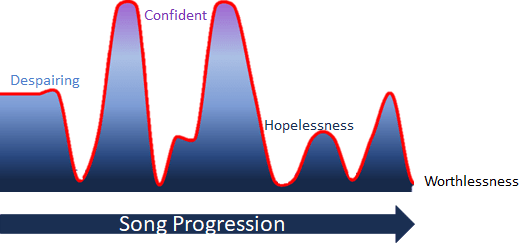
What I found is that for most of the song, I did detect deeply sad emotions. However, there were also periods during the song were I felt an empowering confidence emotion.
The chart below summarizes the emotions I experienced and for what percentage of the song I believe that I experienced these emotions:
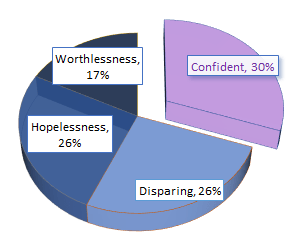
So just how blue was this blues song? For my selected song, my answer is approximately 70% is blue. That is , during over 70% of the song duration I believe I detected the feelings of longing, loss, and desire that blues music is known to give rise to.
This was a fairly fun activity and it will be interesting to see how my emotional perceptions will compare to those of others.
 rozinthemoment