For those you who know me very well, you know that I greatly enjoy listening to all types of blues music. But, my hands down favorite type is listening to the music of Black women classical blues era artists from the 1920s. Talented Black women classical blues era artists, like Bessie Smith and Ma Rainey, were trend setting ground breakers in the release and overwhelming acceptance of their powerful style of music. Truly American originated music, the blues is, emanating from the very heart and experiences of southern Black slave culture.
Given my love of blues music, I often spent time investigating particular aspects of its structure, history, and impact. And while doing so, I came across the musical theory notion of a blues scale. Now I am a highly amateur ‘musician’ who for years has been working at learning to play tunes on either my guitar or keyboard. That is, I am in no way claiming to have any level of professional expertise in the area of music theory. But I do have a high interest in blues music; so, I read around and discovered that there were some interesting connections between the blues scale and fundamental mathematics fraction principles.
The Blues Music Scale
I read that any music scale is considered an ordered sequence of notes in ascending or descending pitch. Turns out that there are many different types of blues scales. I found this website provided a fairly easy to follow novice level introduction to blues scales.
I learned that the blues scale is constructed as an extension of a major music scale where some of the major scale notes are replaced by what are referred to as blues notes. For instance the image below shows the piano keys and letters for the major scale in note C:
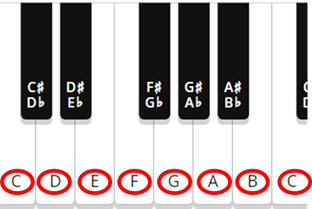
The note letters CDEFGABC, circled in red, make up the notes for the major music scale in note C. The scale sounds like this:
It appears that one of the many blue scales can be obtained from this major scale in note C, by applying the following note change formula:

To apply this blues scale note change formula, to the collection of notes CDEFGABC from the major scale in C, do the following:
- Keep the first letter C
- Drop the second letter D
- Add the flat of the third letter E
- Drop the fourth letter F
- Add the flat of the fifth letter G
- Keep the fifth letter G
- Drop the sixth letter A
- Add the flat of the seventh letter B
- Drop the eighth letter C
The resulting collection of note letters used to form this blues scale in C is CEbGGbBb. And, the piano notes keyboard image from above changes to the following:
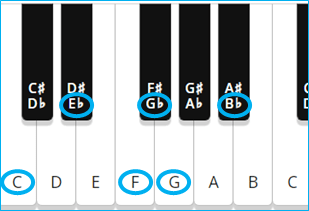
This blues scale sounds like the following:
I found this blues scale introduction information very interesting and have begun to use this knowledge to tap out a few blues sounding tunes on my keyboard. However , since the notes transition instructions from the major scale note letters to the blues scale note letters were provided using a formula, I wondered further if there was a mathematics relationship underlying the formula.
Pythagoras and Fractions
It turns out that there is a mathematical relationship at work and it has its origins with none other than Pythagoras. And yes, this is the same Pythagoras that is known for the right triangle sides measurement formula we learned about in high school geometry.
Pythagoras uncovered a number of interesting relationships between mathematics and music scales. I’ll just mention two of them below:
- There is a common frequency ratio (approximately .059463) that separates each half step note between the root note and the ending note of a music scale
- Two notes sound pretty good when played together if the ratio, between the frequency of the notes, is a simple fraction.
Common ratios? Simple fractions? Sounds like middle school mathematics topics and yes, there are definitely relationships at work here between mathematics and music scales! This needs further unpacking and exploration. A hands on session is forth coming.
 rozinthemoment