It’s wonderful that there are so many talented individuals who are devoting time and their expertise to investigate and report on issues of importance to our seasoned adult population. In fact, just recently I came upon a website summarizing findings from the National Institute on Aging (NIA) funded National Health & Aging Trends Study (NHATS). The study has been ongoing since 2011 and is led by researchers from John Hopkins University and the University of Michigan. These researchers are interested in investigating how daily life activities change for older adults with age.
The Study Participants
Volunteer participants, for the duration of the study, are non-nursing home resident seasoned adults aged 72 and older. They are administered survey questions about their health, home life, relationships, and community. What’s more, participants are asked to perform several simple mobility activities such as standing, getting up from a chair, and walking. Researchers have tracked participant survey responses over the duration of the study, taken measurements, and have summarized on the NHATS website details regarding participant activity level changes over time.
Changes in Mobility Over Time and Age
If you have an opportunity, I would encourage you to visit the NHATS website and browse through the many findings that are reported there. It was the participant mobility charts and numerical summaries findings, posted to the website, that caught my eye as I browsed. There are numerous charts posted that show low strength trends, across the duration of the study, by specific mobility areas and participant subgroups.
I decided to take a closer look at the reported low strength trends shared, by participant age group categories, in grip strength, balance, walking, and standing up from a chair. I don’t have access to the actual dataset; but I ‘eye-balled’ the trendlines presented on the internet posted charts, estimated values, and created by own summary dataset to explore. I was able to generate the following table estimating the average percentage of study participants, by age group and across the duration of the study, who measured at low strength for balance, standing up from a chair, grip strength, and walking.
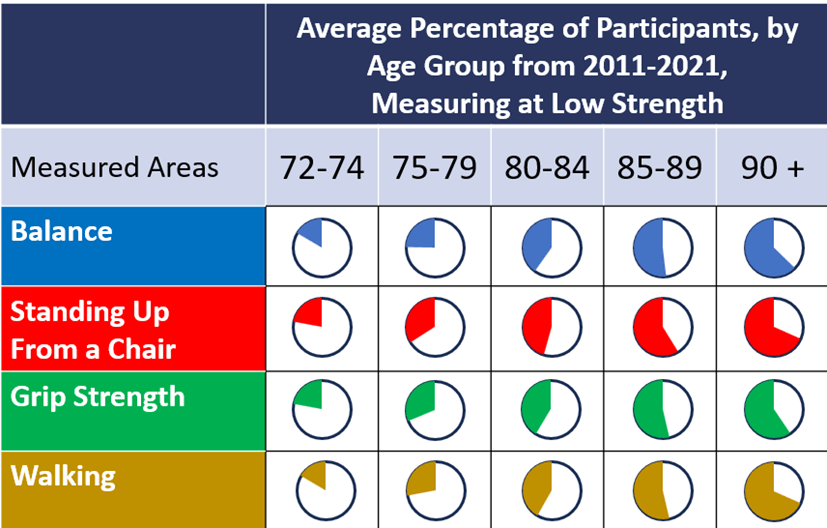
From my table it appears that the low strength measures associated with the ability to stand up from a chair showed larger average percentage difference decreases, than for the other measured mobility areas, as the study participants aged. And, the table appears to also show that by the age of 85, that within all four measured mobility areas at least 50% or more of the study participants on average are reported to have experienced low strength.
This is quite an amazing bit of seasoned adult progressive mobility low strength information to ponder. How much should we worry?
Thankfully, it appears that there are talented artificial intelligence (AI) experts who are working on solutions. Their efforts could possibly result in products developed that may help us as we age to get standing up and continuing to do many of the things that we love and enjoy. I will write about mobility technology advances soon !
 rozinthemoment